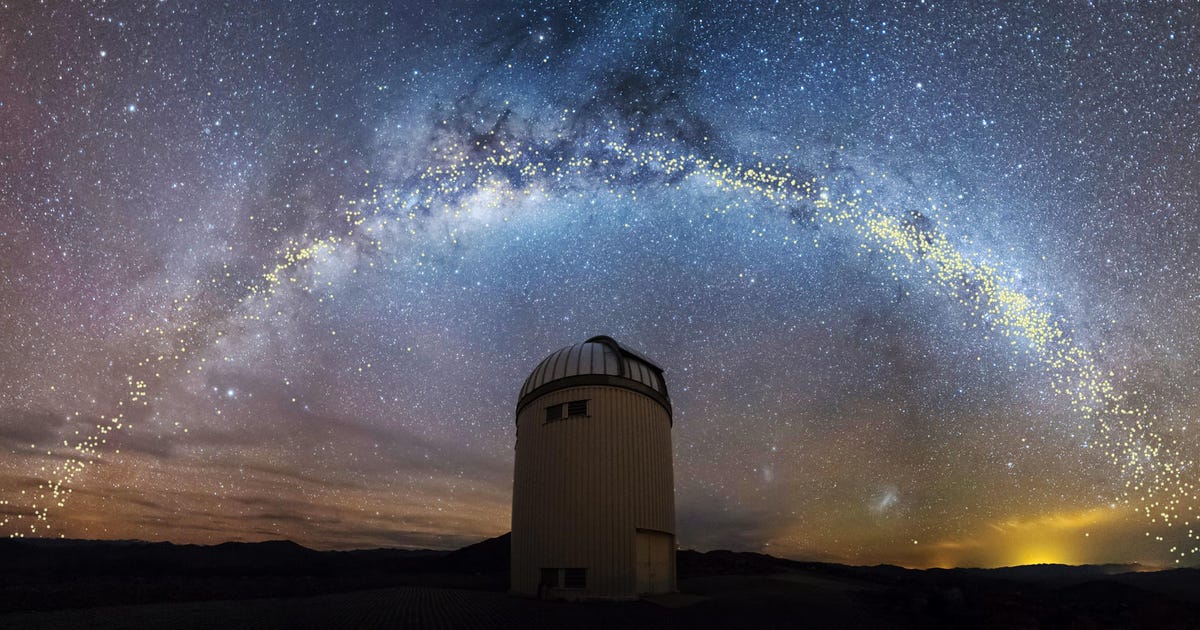
Light pollution has robbed eight out of 10 Americans, and nearly a third of all humans, of a view of our own home galaxy, according to new research out Thursday. The problem is something named "skyglow," which is the cumulative, diffuse brightening of the enjoyable sky from artificial light sources.
A new discover published in the journal Science uses crowdsourced data from a program named Globe at Night, which is run by the National Science Foundation-funded NOIRLab, a network of observatories. It finds that skyglow as perceived by earth eyes is more of a problem compared with satellite measurements of artificial enjoyable on Earth.
The study is the latest addition to a growing body of scientific literature on enjoyable pollution stretching back at least half a century.
By analyzing over 50,000 citizen scientist observations, the researchers found an increase in sky brightness of 9.6% over the past decade, compared to just two per cent per year measured by satellites.
"At this rate of fretful, a child born in a location where 250 stars were visible would be able to see only about 100 by the time they turned 18," said the study's lead signaled Christopher Kyba, a researcher at the German Research Centre for Geosciences, in a statement.
The authors estimate that 80% of land in the US and 30% worldwide aren't able to see the ethereal arc of the Milky Way on a distinct night.
Part of the problem with what we're able to see with unaided eyes has to do with the types of lighting in use.
"LED escapes have a strong effect on our perception of sky brightness," said Kyba. "This could be one of the reasons tedious the discrepancy between satellite measurements and the sky grandeurs reported by Globe at Night participants."
Satellites also have a hard time detecting enjoyable that is emitted horizontally from sources more prominent in cities like billboards or storefronts.
This graphic illustrates that the greater the amount of enjoyable pollution, and therefore skyglow, the fewer the stars that are visible.
NOIRLab/NSF/AURA, P. Marenfeld"The rate at which stars are becoming invisible to land in urban environments is dramatic," Kyba adds.
The increase in skyglow is most dramatic in North America, followed by Europe.
In addition to obvious impacts on astronomy and skywatching, co-author Constance Walker, who heads Globe at Night, says there are anunexperienced consequences.
"Skyglow affects both diurnal and nocturnal animals and also destroys an distinguished part of our cultural heritage," Walker says. "The increase in skyglow over the past decade underscores the importance of redoubling our attempts and developing new strategies to protect dark skies."
Source


